
When you step into the world of forex trading, one of the foundational concepts you must master is currency pairs — and among them, the major forex pairs hold a special place. These pairs are the most traded, most liquid, and generally carry lower trading costs compared to lesser-known pairs.
In this article, you’ll learn:
- What defines a “major” forex pair
- Why majors are so heavily traded
- Detailed profiles of each major pair
- Key drivers and trading tips
- Risks to watch out for
Let’s get started.
What Makes a Forex Pair a “Major”?
A currency pair is simply two currencies being traded against each other — one is the base currency, the other the quote (or counter) currency. When you buy the pair, you are buying the base and selling the quote; when you sell, you are selling the base and buying the quote. Investopedia+1
The term major forex pairs typically refers to the most traded currency pairs in the global foreign exchange (FX) markets — and importantly, all of them involve the U.S. dollar (USD). Put simply: if a pair includes USD and another major global currency, it often qualifies as a “major.” cmcmarkets.com+3Babypips.com+3OANDA+3
Key reasons why major pairs are distinct:
- High liquidity and tight spreads — many participants trade them, so you can enter and exit trades without large slippage. Saxo Bank+2IG+2
- Regular economic data and news flow — the countries behind these currencies publish frequent macro data (GDP, inflation, employment, central bank actions), which helps maintain transparency and volatility.
- Lower trading costs — because of competition and heavy volume, spreads (the difference between buy and sell prices) for majors tend to be narrower.
- Predictability and technical behavior — due to the large number of participants, major pairs often conform more to technical analysis patterns than more obscure pairs.
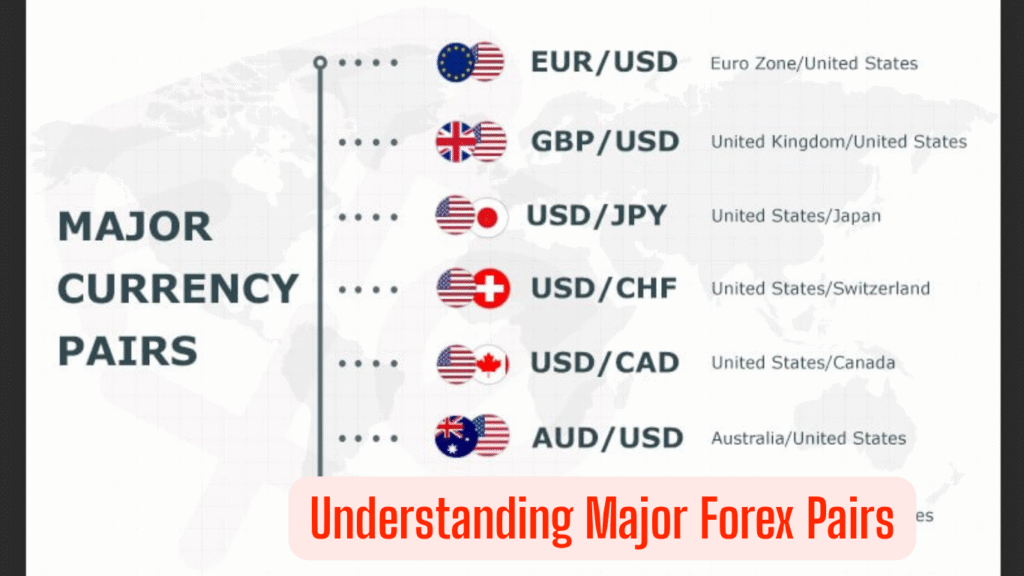
There is some variation in how many “majors” are recognized, but a commonly accepted list comprises seven major pairs:
EUR/USD, USD/JPY, GBP/USD, USD/CHF, AUD/USD, USD/CAD, NZD/USD. Saxo Bank+4Babypips.com+4IG+4
However, many traders focus on the “core four” (EUR/USD, USD/JPY, GBP/USD, USD/CHF) because they typically have the highest volumes and best trading conditions. IG+2Dukascopy+2
The Major Forex Pairs — A Closer Look
Below is a brief profile of each major pair, highlighting their characteristics, drivers, and trading considerations.
1. EUR/USD (Euro / U.S. Dollar)
- The single most traded currency pair in the world. Dukascopy+3Babypips.com+3TradingView+3
- Often called the “fiber” in trader slang.
- Price action is influenced by European Central Bank (ECB) policy, U.S. Fed decisions, eurozone economic data, U.S. macro indicators, and global risk sentiment.
2. USD/JPY (U.S. Dollar / Japanese Yen)
- A key cross reflecting the strength between U.S. and Japanese economies.
- Sensitive to interest rate differentials, carry trade flows, and risk appetite (the yen often acts as a safe-haven currency).
- Traders often monitor Bank of Japan decisions and policy divergence.
3. GBP/USD (British Pound / U.S. Dollar)
- Known colloquially as “cable” (a term born from historic transatlantic telegraph cable communications) Wikipedia
- Generally more volatile than EUR/USD.
- Influenced by UK economic news (BoE decisions, inflation, Brexit-related developments) and U.S. strength.
4. USD/CHF (U.S. Dollar / Swiss Franc)
- The Swiss franc (CHF) is often seen as a safe-haven currency. During times of global uncertainty, USD/CHF may move accordingly.
- Swiss National Bank (SNB) policies and Swiss macro data can influence this pair.
5. AUD/USD (Australian Dollar / U.S. Dollar)
- One of the “commodity pairs” — Australia is heavily commodity- and resource-export oriented.
- Influenced by global commodity prices (especially metals, coal, iron ore), China’s economy, and risk sentiment.
6. USD/CAD (U.S. Dollar / Canadian Dollar)
- Another commodity-linked pair — Canada is a major oil exporter, so USD/CAD correlates with crude oil prices.
- Monitoring global oil markets, OPEC decisions, Canadian central bank policy, and U.S.-Canada trade relations is essential.
7. NZD/USD (New Zealand Dollar / U.S. Dollar)
- Influenced by New Zealand’s agricultural exports, dairy prices, and China’s demand (since NZ is commodity-export oriented).
- Interest rate differentials between RBNZ (Reserve Bank of New Zealand) and Fed are closely watched.
Why Trade Majors — Benefits & Strategy Tips
Trading major pairs offers several advantages and strategic angles for forex traders.
| Advantage | Explanation |
|---|---|
| Lower costs & tighter spreads | Because of high liquidity and competition among brokers, majors often have the lowest spreads. |
| Abundant analysis & information | You’ll find countless daily news, reports, and analyses for majors, aiding decision-making. |
| Better execution & less slippage | Liquidity ensures that large orders are filled more reliably without causing big price shifts. |
| Suitability for many trading styles | From scalping and day trading to swing and longer-term trades, majors provide opportunities across timeframes. |
| Better technical pattern behavior | Price action tends to respect support/resistance, trend lines, and technical zones more reliably in major pairs. |
Strategy Tips
- Follow the economic calendar
Key releases (interest rates, CPI, jobs) significantly influence majors. Avoid trading through high-impact announcements unless you’re experienced. - Watch interest rate differentials
The difference in yields between two currencies is a powerful driving force (carry trade, flow of funds) behind currency movements. - Use correlation analysis
Majors often move in relation to each other (e.g., EUR/USD vs USD/CHF often trade inversely). Understanding correlations helps manage risk. - Mind liquidity times
Trading during the overlap of London and New York sessions typically yields tighter spreads and more volatility — beneficial for entries and exits. - Risk management is key
Use stop-losses, proper sizing, and avoid over-leverage. Even majors can experience sharp moves during news or unexpected events.
Common Pitfalls & Risks to Watch
While major forex pairs are among the “safer” options in forex, they’re hardly risk-free. Be aware of:
- Overnight gaps / weekend risk
Markets close over weekends; global events can cause gaps when they reopen. - Slippage & execution risk under volatility
During major news and surprises, spreads widen and executions may slip. - Central bank surprises & policy shifts
Unexpected rate decisions or forward guidance can shake markets. - Correlated exposure
Holding multiple positions in correlated major pairs can amplify risk. - Overtrading during low-volume hours
Avoid trading majors when volume is low (e.g., late U.S. or early Asia sessions) to reduce fake breakouts.
How Buying and Selling in Majors Works (Recap)
To connect back to your initial interest (as in the BabyPips article on “buying and selling currency pairs”):
- When you buy a major pair (go long), you are buying the base currency and selling the quote currency.
- When you sell (go short), you are selling the base and buying the quote.
- For example, in EUR/USD, if you believe the euro will strengthen versus the dollar, you buy EUR/USD.
- The bid price is where brokers buy from you; the ask (offer) is where they sell to you. The spread is their profit cushion. Investopedia+2Babypips.com+2
When trading majors, always consider:
- Pip value (because majors often have tight pip value)
- Lot size (micro, mini, standard)
- Leverage and margin requirements
- The impact of news on volatility and spreads
Optimizing for SEO & Readability (Tips from This Article)
To help your own content rank well and engage users, consider:
- Use the keyword “major forex pairs” (and synonyms) naturally in headings and body.
- Include supporting keywords: “liquidity,” “spread,” “currency pair,” “trading strategy,” and “volatility.”
- Provide value via examples, tips, and risk warnings.
- Break content into headings and subheadings (for readability).
- Use internal linking if you have other forex content (e.g. linking to articles on individual pairs, strategies, glossary).
- Cite authoritative sources or statistics to build credibility (like BIS, Big brokers, central banks).
- Keep paragraphs concise (3–5 lines) to improve mobile readability.
Summary
Major forex pairs are the backbone of the currency trading world. By definition, each involves the U.S. dollar paired with another globally significant currency. Traders favor them for their liquidity, tighter costs, and wealth of information and tools. The seven often recognized majors (EUR/USD, USD/JPY, GBP/USD, USD/CHF, AUD/USD, USD/CAD, NZD/USD) each carry their own economic drivers and behavior patterns. While majors provide relative stability compared to exotic pairs, they are not without risk — understanding central bank policies, economic differentials, and proper risk controls is essential for success.
If you like, I can also write separate deep-dive articles for each major pair (e.g. “EUR/USD trading strategies”) or provide real-time data charts. Let me know!
Disclaimer
Disclaimer: This article is for informational and educational purposes only. It does not constitute financial advice, and you should not treat it as such. Forex trading involves risk and may not be suitable for all investors. Always conduct your own due diligence and, if necessary, consult with a licensed financial advisor before trading. Past performance is not indicative of future results, and losses can exceed deposits.
FAQs
1. What are major forex pairs?
Major forex pairs are the most traded currency pairs in the global forex market. Each major pair includes the U.S. dollar (USD) and another strong global currency, such as the euro (EUR), Japanese yen (JPY), British pound (GBP), Swiss franc (CHF), Australian dollar (AUD), Canadian dollar (CAD), or New Zealand dollar (NZD). These pairs are favored by traders for their high liquidity, tight spreads, and consistent price movements.
2. Why are major forex pairs popular among traders?
Major forex pairs are popular because they offer high trading volume, tight bid-ask spreads, and abundant market data. This makes them ideal for both beginners and professionals. Since these currencies represent the largest economies in the world, they are less prone to extreme volatility compared to exotic or minor pairs.
3. Which is the most traded major forex pair?
The EUR/USD (Euro/US Dollar) is the most traded forex pair globally, accounting for roughly 20–25% of total forex transactions. Traders prefer it because of its high liquidity, predictable trends, and the influence of two major economies — the Eurozone and the United States.
4. What factors affect the movement of major forex pairs?
Several key factors impact major forex pairs, including interest rate differentials, economic indicators (like GDP, inflation, and employment reports), central bank policies, and geopolitical events. Additionally, global risk sentiment — whether investors are seeking safety or higher returns — also influences how these pairs move.
5. Are major forex pairs good for beginners?
Yes, major forex pairs are often recommended for beginners because they are easier to analyze, have lower trading costs, and offer stable liquidity. Beginners can learn price action, risk management, and strategy building more efficiently when trading majors compared to exotic or illiquid pairs.