
In the high-stakes world of Forex trading, where volatility is a constant companion, success is defined not just by profits but by the ability to survive. The single most critical factor separating professional traders from amateurs is disciplined risk management, and at the heart of this discipline lies a powerful tool: the Forex trading risk calculator. This software or online tool is not merely a convenience; it is a strategic imperative that mathematically determines the precise position size for any trade based on your predefined risk tolerance. By automating this calculation, it removes emotion from the equation and enforces a level of discipline that is fundamental to long-term profitability.
This definitive guide will explore what a Forex risk calculator is, how it functions, and why it is arguably the most important tool in a trader’s arsenal. We will break down its core components, walk through a practical example, and demonstrate how integrating this tool into your daily routine can transform your trading approach from speculative gambling to calculated strategy.
What is a Forex Risk Calculator and Why is it Non-Negotiable?
A Forex risk calculator, often synonymous with a position size calculator, is a specialized tool that automatically calculates the ideal trade size (in lots) to ensure you never risk more than a predetermined percentage of your account capital on a single trade.
Its importance cannot be overstated for several reasons:
- Eliminates Emotional Decision-Making: By pre-defining your risk, you prevent the common pitfalls of “revenge trading” or “doubling down” on a losing position out of frustration or greed.
- Enforces the 1-2% Rule: A cornerstone of professional trading is to never risk more than 1-2% of your total account balance on a single trade. The calculator makes adhering to this rule effortless and precise.
- Quantifies Risk: It transforms abstract risk into a concrete, manageable number. You know your exact maximum potential loss before you even enter the market.
- Promotes Consistency: By using the same risk parameters for every trade, you create a consistent, repeatable process that can be analyzed and improved over time.
Deconstructing the Tool: The Four Core Components
To use a risk calculator effectively, you must understand the four essential pieces of information it requires.
1. Account Currency and Balance
This is your starting point. You must input your total account equity and the currency it is denominated in (e.g., USD, EUR, GBP). The calculator uses this to determine what 1% or 2% of your capital represents in monetary terms.
2. Risk Percentage Per Trade (%)
This is your strategic decision. This is the maximum percentage of your account you are willing to lose on the trade in question. For most traders, this should be a fixed number between 0.5% and 2%. A 1% risk means if you have a $10,000 account, your maximum loss on this trade is $100.
3. Stop-Loss in Pips
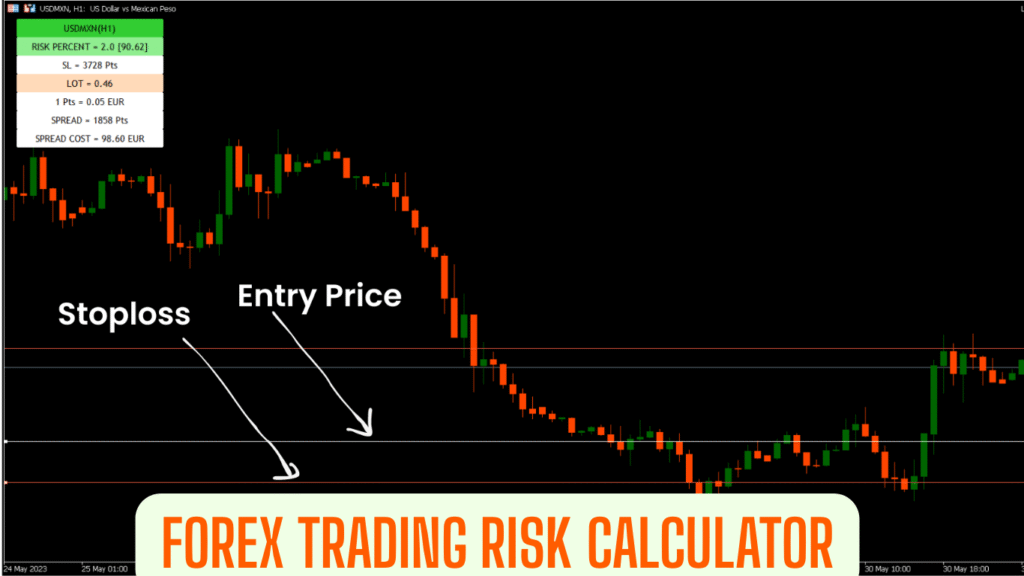
Your stop-loss is your predetermined exit point for a losing trade. The distance from your entry price to your stop-loss, measured in pips, is a critical variable. A wider stop-loss means you can trade a smaller position size to stay within your risk tolerance, while a tighter stop-loss allows for a larger position. Your stop-loss should be based on technical analysis (e.g., support/resistance levels), not on the desired position size.
4. Currency Pair and Pip Value
The calculator needs to know which pair you are trading (e.g., EUR/USD, GBP/JPY) because the monetary value of a single pip varies between pairs. For pairs where the USD is the quote currency (the second currency), the pip value is typically fixed. For cross-pairs, the calculator automatically performs the necessary conversions.
A Step-by-Step Walkthrough: Calculating Position Size in Action
Let’s make this practical. Assume the following trade setup:
- Account Balance: $10,000 (USD)
- Risk Per Trade: 1.5%
- Currency Pair: EUR/USD
- Stop-Loss: 25 pips
Step 1: Calculate Maximum Monetary Risk
1.5% of $10,000 = $150
This is the absolute maximum you can afford to lose on this trade.
Step 2: Calculate Risk Per Pip
You know your total risk is $150, and your stop-loss is 25 pips away.
$150 / 25 pips = $6 per pip
This means for every pip the market moves against you, you will lose $6.
Step 3: Determine Position Size (Lots)
For a standard lot (100,000 units) in EUR/USD, the pip value is approximately $10. For a mini lot (10,000 units), it’s $1, and for a micro lot (1,000 units), it’s $0.10.
Since your risk is $6 per pip, you would need a position size of 0.6 standard lots (which equates to 6 mini lots or 60 micro lots). At this size, a 25-pip loss would result in a $150 loss, exactly hitting your predefined risk limit.
A quality risk calculator performs all these complex calculations instantly, giving you the correct lot size in seconds.
Advanced Applications: Beyond Basic Calculations
Modern risk calculators can handle more complex scenarios that reflect real-world trading:
- Trading Cross-Currency Pairs: If your account is in USD but you are trading AUD/JPY, the calculator will automatically convert pip values and ensure your risk is accurate.
- Accounting for Leverage: While the calculator focuses on risk relative to equity, it inherently works with your broker’s leverage. It ensures your position size does not exceed your margin requirements.
- Integrating Risk-Reward Ratios: Sophisticated traders use the calculator in tandem with risk-reward ratios. By knowing your risk (stop-loss), you can calculate the potential reward (take-profit) needed to maintain a favorable ratio, such as 1:2 or 1:3.
Common Pitfalls and How to Avoid Them
Even with a calculator, errors in input can lead to disastrous outcomes.
- Incorrect Stop-Loss Placement: The most common error. Your stop-loss must be based on market structure, not a random number. A miscalculated stop-loss leads to an incorrectly sized position.
- Ignoring Spread and Slippage: For very short-term strategies like scalping, the spread (the difference between the bid and ask price) can significantly impact the effective risk. Factor this into your calculations.
- Overcomplicating the Process: The goal is consistency. Find a simple, reliable calculator and use the same risk percentage for the majority of your trades.
Conclusion: Making the Risk Calculator Your Trading Co-Pilot
A Forex risk calculator is more than just a piece of software; it is the embodiment of a professional trading mindset. It is the line in the sand that protects your capital from the unpredictable whims of the market. By making it an non-negotiable part of your pre-trade checklist, you shift your focus from “How much can I make?” to the more crucial question: “How much can I afford to lose?”
Integrating this tool into your routine is the definitive step away from impulsive gambling and toward strategic, disciplined money management. In the relentless pursuit of trading success, the risk calculator isn’t just a tool for survival—it is your most powerful weapon for sustainable growth.
Disclaimer
This article is for informational and educational purposes only and does not constitute financial advice, investment recommendation, or an offer or solicitation to buy or sell any financial instruments. Trading foreign exchange (Forex) on margin carries a high level of risk and may not be suitable for all investors. There is a possibility that you may sustain a loss equal to or greater than your entire investment. Therefore, you should not invest or risk money that you cannot afford to lose. The use of a risk calculator does not eliminate trading risk nor guarantee profits. The high degree of leverage can work against you as well as for you. Past performance is not indicative of future results. You should be aware of all the risks associated with Forex trading and seek advice from an independent financial advisor if you have any doubts.
FAQs
1. What is the most important piece of information I need for the risk calculator?
While all inputs are important, your Stop-Loss in Pips and your predefined Risk Percentage are the most critical. The stop-loss, based on technical analysis, defines the trade’s potential loss distance, while your risk percentage (e.g., 1% of your account) defines the maximum financial loss you can tolerate. The calculator uses these two values to determine the perfect position size that keeps your loss within your comfort zone.
2. Can I use the same risk percentage for every trade?
Yes, and this is highly recommended for maintaining discipline and consistency. Using a fixed risk percentage (typically between 0.5% and 2%) for every trade ensures that no single loss can significantly damage your trading capital. This creates a stable, mathematical framework for growth and prevents emotional decisions like risking more after a losing streak to “make it back.”
3. What’s the difference between a risk calculator and a profit calculator?
A Risk Calculator (or Position Sizer) is used before you enter a trade to determine how much you can lose and set the appropriate trade size. A Profit Calculator is often used after a trade is placed to project potential profit based on your position size and a target price. The risk calculator is about capital preservation, while the profit calculator is about reward projection.
4. Do I still need a risk calculator if my broker has a built-in one?
Absolutely. Using a reliable, standalone risk calculator as part of your pre-trade planning routine is a best practice. It forces you to consciously define your risk before you are even in the trading platform, removing the temptation to adjust your stop-loss to fit a desired position size. It adds a crucial layer of disciplined forethought to your process.
5. How does the calculator work for currency pairs where the USD isn’t the quote currency?
A sophisticated risk calculator automatically handles the conversion for cross-currency pairs (e.g., EUR/GBP, AUD/JPY). It calculates the pip value for that specific pair and then converts that value into your account currency (e.g., USD) using the current exchange rate. This ensures your risk calculation remains accurate regardless of the currency pair you are trading.