
In the fast-paced world of financial markets, mastering forex trading strategies alongside crypto and forex trading, merged with solid financial principles, can position you for consistent success. A smart approach is to combine multiple strategies, adjust to market conditions, and always manage risk. This article will guide you through proven strategies, how they apply to both forex and crypto trading, and essential financial mindset tips to stay ahead.
What Are Forex Trading Strategies?
A forex trading strategy is a systematic approach to deciding when to enter a trade, when to exit, and how much risk to take. Strategies are built using tools from technical analysis, fundamental analysis, sentiment, or a combination. Successful traders rarely stick to one rigid strategy—instead, they adapt across different market conditions.
When you expand into crypto and forex trading, many of these same strategies apply, since both markets respond to momentum, volatility, and sentiment. But crypto markets are typically more volatile and influenced by news, so risk control becomes even more critical.
Core Strategy Types & How to Use Them
Here are the main categories of strategies you should know and how to combine them.
1. Trend Trading Strategy
- Concept: Identify a sustained direction (uptrend or downtrend) and trade in that direction.
- Tools: Moving averages, trendlines, channels.
- How to apply:
- Wait for consolidation or minor pullback.
- Use the trendline or moving average as a dynamic support or resistance.
- Enter when price resumes in trend direction, with stop-loss under the pullback.
- In crypto: Because trends often accelerate quickly, tighten your stop-loss and consider partial exits.
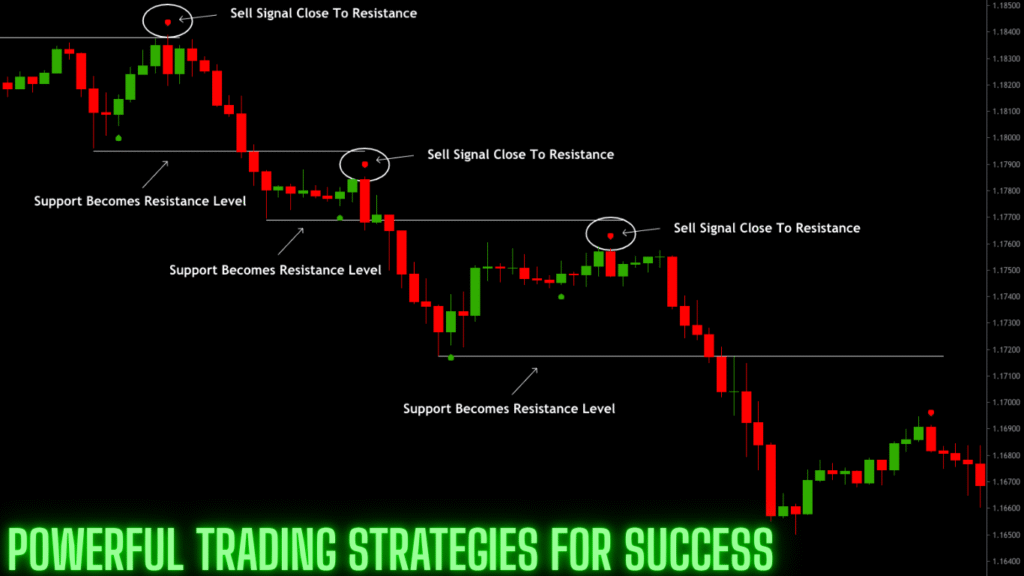
2. Support & Resistance (Range) Strategy
- Concept: Price often bounces between defined levels (support floor and resistance ceiling).
- Tools: Horizontal lines, pivot points.
- How to apply:
- Buy near support, sell near resistance (in range-bound market).
- Look for breakout confirmation when price breaks a level.
- In volatile markets: Range patterns may break often, so use confirmation (volume, momentum) before taking breakout trades.
3. Breakout & Momentum Strategy
- Concept: When price breaks out of consolidation or a key level, follow the momentum.
- Tools: Bollinger Bands, volatility indicators, momentum oscillators.
- How to apply:
- Wait for a squeeze or tight range.
- Enter when price breaks above or below with strong momentum.
- Use a stop just inside the breakout zone.
- In crypto/forex: Be careful of false breakouts. Wait for a confirmation candle or retest.
4. Swing & Position Strategy
- Concept: Hold trades from multiple hours to several days/weeks, capturing medium to larger price swings.
- Tools: Multi-timeframe analysis, fundamentals, major trend indicators.
- How to apply:
- Use daily or 4H charts to identify the trend.
- Enter on pullbacks using indicators or chart patterns.
- In crypto: Fundamentals (e.g. major news, blockchain updates) can drive swings. Combine technical and fundamental signals.
5. Scalping / Intraday Strategy
- Concept: Capture small profits repeatedly during intraday sessions.
- Tools: Fast oscillators, short-term moving averages, tick/volume charts.
- How to apply:
- Work on 1-5 minute charts.
- Enter small moves with tight stop-losses.
- Close trades quickly or trail stops.
- Caution: Requires discipline, fast decisions, low spreads, and very strict risk management.
6. Carry Trade & Interest Rate Strategy
- Concept: Buy a currency with higher interest rate and sell one with lower rate, profiting from interest differential.
- Tools: Economic calendars, rate differentials, swap rates.
- How to apply:
- Monitor central bank policies and interest rate expectations.
- Hold positions longer to collect positive swap (if applicable).
- In crypto: Less common because cryptos typically do not carry interest. But yield strategies in crypto (staking, lending) may resemble this principle.
7. Hedging & Portfolio Strategy
- Concept: Protect your open trades or reduce overall risk by holding offsetting positions.
- Tools: Correlation matrices, paired instruments.
- How to apply:
- If you’re long EUR/USD and see downside risk, you may open a short in a correlated pair to reduce exposure.
- In crypto + forex: Hedging across asset classes can reduce volatility risk.
8. Algorithmic & Automated Strategy
- Concept: Use code/algorithms to enter and exit trades based on predefined rules.
- Tools: Trading bots, Expert Advisors (EA), APIs.
- How to apply:
- Define entry/exit logic (trend, breakout, mean reversion).
- Backtest thoroughly, forward test in demo environment.
- In volatile markets: Automation helps avoid emotional mistakes, but still needs oversight and risk checks.
Building Your Strategy Portfolio
- Mix strategies: Use a trend strategy in trending markets, range during sideways periods, and scalping in high liquidity sessions.
- Multiple time frames: Use higher timeframe for trend (e.g. daily), lower timeframe for entries (e.g. 1H or 15 min).
- Define clear rules: Entry signal, stop-loss, take-profit, trade size.
- Risk per trade: Limit risk (e.g. 1–3% of trading capital per trade).
- Backtesting & forward testing: Try your strategies on historical data and paper/demo accounts first.
- Review & adapt: Periodically assess performance; refine or discard strategies that underperform.
Integrating Crypto + Forex Trading
Because forex and crypto share many market behaviors, the same strategies often apply, but with adjustments:
- Higher volatility: Use tighter stops or smaller position sizes.
- Liquidity differences: Some crypto pairs have lower liquidity outside peak hours.
- News sensitivity: Crypto reacts strongly to announcements (regulation, listings, forks).
- Correlation awareness: Watch cross-market effects (e.g. USD weakness affects many forex and crypto pairs).
- Hybrid strategies: Combine forex trend signals with crypto momentum to catch cross-asset moves.
Finance Mindset & Management Tips
- Capital allocation: Don’t commit all funds to one trade or strategy.
- Diversification: Spread exposure across strategies, asset classes (forex, crypto, commodities).
- Discipline & consistency: Follow your rules; avoid emotional deviations.
- Drawdown control: If you suffer several losses in a row, pause and reassess.
- Continuous learning: Markets evolve; read, test new strategies, review mistakes.
- Psychological readiness: Accept that losses are part of trading. Maintain mental balance.
Sample Strategy Workflow (Example)
- Use the daily chart to identify trend direction (up or down).
- Switch to the 4-hour chart to find a pullback or consolidation zone near a moving average.
- On the 1-hour or 15-minute chart, wait for confirmation (e.g. bullish candlestick, RSI crossing, volume spike).
- Enter the trade with defined stop-loss and take-profit (risk–reward ratio ≥ 1:2).
- Monitor trade; if price moves favorably, consider trailing stop or partial exit.
- Exit when one of: target hit, stop-loss reached, or reversal signal appears.
Disclaimer
Trading forex, CFDs, and cryptocurrencies involves a high level of risk. You may lose more than your initial investment. This content is for educational and informational purposes only, and does not constitute financial advice, trade recommendations, or an endorsement of any strategy or broker. Always perform your own research, use proper risk management, and consider consulting with a licensed financial advisor before engaging in trading.
FAQs
1. What is the most effective forex trading strategy?
There is no single “best” strategy. Trend trading, support/resistance, and breakout strategies are popular, but effectiveness depends on market conditions and your risk tolerance.
2. Can I apply forex strategies to crypto trading?
Yes. Many forex strategies such as trend following and breakout trading also work in crypto markets. However, crypto is more volatile, so you should use tighter stop-losses and smaller position sizes.
3. How much money do I need to start trading forex or crypto?
Some brokers allow you to begin with as little as $10. However, for meaningful risk management, many traders recommend starting with at least $100–$500.
4. Is trading forex and crypto profitable for beginners?
It can be, but it is also risky. Beginners should practice on demo accounts, learn basic strategies, and focus on risk management before investing real money.
5. Do I need to learn both technical and fundamental analysis?
Yes. Technical analysis helps you identify entry and exit points, while fundamental analysis (like interest rates or news in forex, and updates in crypto) provides context for long-term trends. Combining both strengthens your strategy.