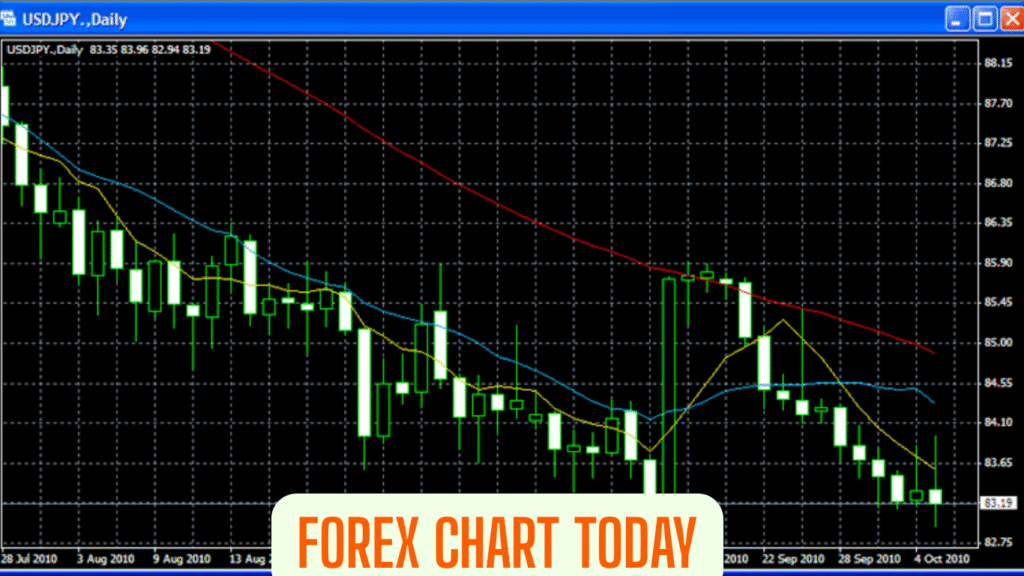

Navigating the foreign exchange market requires more than just understanding currency pairs—it demands the ability to interpret price movements through forex charts. These visual representations of price action serve as the primary tool for technical analysts and discretionary traders worldwide. Unlike static data, live forex charts provide a dynamic, real-time window into market sentiment, allowing traders to identify trends, patterns, and potential entry and exit points. In today’s fast-moving market, being able to accurately read and analyze these charts is not just an advantage; it’s a necessity for anyone serious about currency trading.
This comprehensive guide will provide an analysis of today’s key currency movements, break down the essential components of forex charts, and demonstrate how to use this knowledge to develop a structured trading approach.
Today’s Forex Market Snapshot: Key Currency Pair Analysis
The forex market is currently characterized by a mix of clear trends and significant consolidation patterns. The US Dollar shows strength against several major counterparts, while commodity currencies are experiencing pressure amid fluctuating global risk sentiment. The following table provides a technical overview of the most actively traded pairs in today’s session.
| Currency Pair | Current Price | Key Technical Level | Daily Trend | Potential Trade Setup |
|---|---|---|---|---|
| EUR/USD | 1.0830 | Resistance: 1.0880 | Bearish | Sell on rallies toward 1.0880 |
| GBP/USD | 1.2645 | Support: 1.2600 | Neutral to Bearish | Break below 1.2600 could signal further decline |
| USD/JPY | 155.20 | Resistance: 155.50 | Bullish | Buy on dips, target 156.00 |
| AUD/USD | 0.6580 | Support: 0.6550 | Bearish | Sell if 0.6550 support breaks |
| USD/CAD | 1.3650 | Resistance: 1.3680 | Bullish | Buy on breaks above 1.3680 |
| Gold (XAU/USD) | 2,325 | Support: 2,300 | Consolidating | Range trade between 2,300-2,350 |
Understanding the Three Primary Forex Chart Types
To effectively analyze today’s market, you must first understand the different ways price data is presented. Each chart type offers unique advantages, from simplicity to detailed market information.
1. Line Charts: The Big Picture Tool
The line chart is the most fundamental type of forex chart, prized for its simplicity . It is constructed by connecting a series of closing prices over a specific timeframe with a continuous line .
- Best For: Identifying overall trends with minimal market “noise” . They provide a clean, high-level view of market direction, making them ideal for long-term investors or traders who want to quickly gauge the dominant trend.
- Limitation: Lacks detailed information about what happened during the trading period, such as the high, low, and opening price .
2. Bar Charts (OHLC): The Detailed Analyst
Also known as OHLC (Open, High, Low, Close) charts, bar charts provide a more comprehensive view of price action than line charts . Each vertical bar represents a specific time period (e.g., 1 hour, 1 day), with the top showing the highest price and the bottom showing the lowest price . The horizontal tick on the left indicates the opening price, while the tick on the right shows the closing price .
- Key Insight: The relationship between the open and close is a quick sentiment indicator. If the close is above the open, it suggests bullish sentiment for that period, and vice versa .
- Best For: Traders who need to understand market volatility and the full price range for a given period.
3. Candlestick Charts: The Trader’s Favorite
Candlestick charts are arguably the most popular tool among active forex traders . Like bar charts, they display the open, high, low, and close, but they do so in a more visually intuitive way . Each “candlestick” consists of a body and wicks (or shadows).
- The Body: The rectangular area between the open and close prices. A filled or red body typically means the close was lower than the open (bearish). A hollow or green body means the close was higher than the open (bullish) .
- The Wicks/Shadows: The thin lines extending from the top and bottom of the body. They represent the highest and lowest prices of the period .
- Best For: Identifying potential market reversals and continuations through recognizable patterns. The visual nature of candlesticks makes it easier to spot formations like Doji, Hammers, and Engulfing patterns, which can signal shifts in market sentiment .
A Practical Guide to Reading Today’s Forex Charts
Now that you understand the chart types, let’s apply this knowledge to a real-time analysis framework.
Step 1: Identify the Overall Trend
The first step is to determine the market’s direction. The most basic principle of technical analysis is that “the trend is your friend.”
- Uptrend: A series of higher highs and higher lows.
- Downtrend: A series of lower highs and lower lows.
- Range/Ranging Market: Price oscillates between a clear support and resistance level without a definite direction.
Using a higher timeframe, like the 4-hour or daily chart, is most effective for this initial assessment.
Step 2: Locate Key Support and Resistance Levels
Support is a price level where buying interest is strong enough to overcome selling pressure, halting or reversing a decline. Resistance is the opposite—a level where selling pressure overcomes buying pressure, stopping an advance . On today’s charts, these levels are often previous swing highs or lows, psychological numbers (like 1.1000 in EUR/USD), or areas where price has consolidated previously.
Step 3: Apply Basic Technical Indicators
While many complex indicators exist, starting with a few reliable ones is best.
- Moving Averages: These lines smooth out price data to help visualize the trend. A common strategy is to watch for the price to be above a key moving average (like the 50 or 200-period) for an uptrend, or below it for a downtrend. The crossover of a shorter-term average (like the 20 MA) above a longer-term one (like the 50 MA) can also signal a potential trend change .
- Relative Strength Index (RSI): This momentum oscillator measures the speed and change of price movements on a scale of 0 to 100. Readings above 70 suggest a market may be overbought (and due for a pullback), while readings below 30 suggest it may be oversold (and due for a bounce) .
Actionable Trading Plan for Today’s Session
Based on the market snapshot and technical principles, here’s how you might approach the current session:
- For EUR/USD: The pair is in a bearish trend below the key 1.0880 resistance. A trader might look for short-selling opportunities on any price rally that fails to break above this level, targeting a move down toward the next support level.
- For USD/JPY: The clear bullish trend suggests a “buy the dip” mentality. A trader could watch for the price to pull back to a dynamic support level, like the 20-period moving average on the 1-hour chart, as a potential long entry.
- Risk Management is Key: No analysis is complete without a risk management plan. Before entering any trade, determine your stop-loss level (the price at which you will exit if the trade goes against you) and your take-profit level (the price at which you will exit to secure profits). A common rule is to never risk more than 1-2% of your trading capital on a single trade.
Conclusion: From Analysis to Confident Action
Today’s forex charts present a clear picture of a market favoring the US Dollar against most major currencies, with specific opportunities in pairs like EUR/USD and USD/JPY. Remember, proficiency in chart reading comes with consistent practice. Start by focusing on the three main chart types—mastering candlesticks is an excellent first goal—and combine trend analysis with key support/resistance levels. By integrating these technical skills with prudent risk management, you can transform today’s forex charts from simple graphs into a powerful roadmap for potential trading success. The market is always speaking; learning its visual language is your key to listening.
Disclaimer
This article is for informational and educational purposes only and does not constitute financial advice, investment recommendation, or an offer or solicitation to buy or sell any financial instruments. Trading foreign exchange (Forex) on margin carries a high level of risk and may not be suitable for all investors. There is a possibility that you may sustain a loss equal to or greater than your entire investment. Therefore, you should not invest or risk money that you cannot afford to lose. The high degree of leverage can work against you as well as for you. Past performance is not indicative of future results. You should be aware of all the risks associated with Forex trading and seek advice from an independent financial advisor if you have any doubts.
FAQs
1. What is the simplest type of Forex chart for a beginner to understand?
The Line Chart is the most straightforward for beginners. It is created by simply connecting the closing prices of a currency pair over a chosen time period with a continuous line. Its simplicity helps you easily identify the overall market trend without the distraction of the price fluctuations that happen within that period.
2. Why are candlestick charts more popular than bar charts?
Candlestick charts are more popular because they present the same information as bar charts (Open, High, Low, Close) in a more visually intuitive and condensed format. The use of colored “bodies” makes it instantly clear if the period was bullish (often green/white) or bearish (often red/black), and their distinct shapes make it easier to spot well-known reversal or continuation patterns.
3. What is the first thing I should look for on a Forex chart?
The very first step is always to identify the overall trend. Look for a series of Higher Highs and Higher Lows for an uptrend, or Lower Highs and Lower Lows for a downtrend. If you cannot clearly see this, the market might be ranging. Starting with this big-picture analysis on a higher timeframe (like the 4-hour or daily chart) prevents you from getting lost in minor price movements.
4. How do I find important support and resistance levels on today’s chart?
Key Support and Resistance levels are typically found at:
- Previous Swing Highs and Lows: Look for points where the price has recently reversed direction.
- Psychological Levels: Round numbers like 1.1000 in EUR/USD or 150.00 in USD/JPY often act as barriers.
- Areas of Consolidation: Zones where the price has moved sideways for a period indicate a balance between buyers and sellers.
5. Can I create a trading plan just by looking at charts?
Yes, a solid trading plan can be built primarily from chart analysis. Your plan should define the market condition (trending or ranging), identify a clear entry point (e.g., a bounce from support), a stop-loss level (to limit losses if the trade fails), and a take-profit target (e.g., the next resistance level). This technical plan must always be combined with strict risk management, such as not risking more than 1-2% of your capital per trade.