
Forex scalping represents one of the most fast-paced and demanding trading approaches in the financial markets. This high-frequency trading method involves executing numerous trades throughout the day, holding positions for mere seconds to minutes, aiming to capture small price movements of just a few pips per trade. While the profits per trade are minimal, successful scalpers rely on volume and consistency to accumulate gains over time. The approach demands intense focus, lightning-fast execution, and strict discipline, as scalpers operate in a world where opportunities appear and vanish within moments.
Unlike swing or position trading that analyzes broader market trends, scalping focuses exclusively on short-term price action, making it both exhilarating and challenging. This comprehensive guide explores the intricacies of forex scalping strategies, providing actionable insights to help you navigate this demanding trading style effectively in today’s volatile markets.
What is Forex Scalping? Understanding the Core Concept
At its essence, forex scalping is a short-term trading methodology where traders aim to profit from minute price fluctuations in currency pairs. Scalpers enter and exit the market dozens of times daily, with each trade typically targeting small profits between 5-10 pips. This approach requires a different mindset compared to other trading styles, as the scalper’s success depends on quantity of trades and consistency rather than hunting for large, trending moves.
The philosophy behind scalping stems from the understanding that small price movements occur far more frequently than large ones. By capitalizing on these minor fluctuations repeatedly throughout trading sessions, scalpers can potentially generate significant returns over time. However, this strategy comes with unique challenges, including higher transaction costs due to frequent trading and the need for constant screen attention during active market hours.
The Anatomy of a Successful Scalper: Traits and Practices
Successful scalpers share distinct characteristics and operational patterns that differentiate them from other traders:
- Multiple daily executions: Scalpers typically place dozens to hundreds of trades within a single trading day, with each position lasting from seconds to a few minutes at most .
- Focus on minimal gains: Rather than waiting for substantial price swings, scalpers aim to capture tiny price differences, often just 5-10 pips per trade, which accumulate through repetition .
- High leverage utilization: To make these small movements profitable, scalpers often employ higher leverage levels, amplifying both potential gains and risks—though prop firms may cap this at ratios like 1:30 .
- Short-term chart analysis: Scalpers primarily operate on 1-minute or 5-minute charts, monitoring tick-by-tick price action and order flow dynamics .
- Tight risk controls: To manage risk in this high-frequency environment, scalpers implement very close stop-loss orders, typically 5-10 pips, exiting losing trades quickly to minimize losses .
- Technical analysis reliance: Scalpers depend heavily on technical indicators and chart patterns to identify entry and exit points, generally ignoring fundamental factors except for major news events that increase volatility .
Foundations of Effective Forex Scalping
Optimal Currency Pairs for Scalping
Choosing the right currency pairs is critical for scalping success. The most suitable pairs typically exhibit:
- High liquidity: Ensuring ease of entry and exit without significant slippage
- Low spreads: Reducing transaction costs that can erode small profits
- Predictable volatility: Providing adequate movement without excessive unpredictability
The most popular pairs among scalpers include:
- EUR/USD: The world’s most traded pair, known for its tight spreads and high liquidity, with predictable daily fluctuation ranges of 50-100 pips .
- GBP/USD: Offers higher volatility than EUR/USD, suitable for more aggressive scalping approaches, though with slightly wider spreads .
- USD/JPY: Features ultra-tight spreads with deep liquidity and smooth, predictable trends, especially during active trading hours .
Best Timeframes for Scalping
Scalpers operate on significantly shorter timeframes than other traders:
- 1-minute charts: Provide the fastest entry and exit signals but contain more market noise and false signals .
- 5-minute charts: Offer a balance between signal quality and execution speed, with reduced noise compared to 1-minute charts .
- 15-minute charts: Useful for establishing broader context and identifying micro-trends while using shorter timeframes for actual trade execution .
Essential Scalping Indicators
Successful scalpers combine multiple technical indicators to confirm signals:
- Moving Averages: Scalpers often use Exponential Moving Averages (EMAs) for their responsiveness to recent price action. Common setups include the 5 EMA or 9 EMA for short-term momentum shifts, sometimes combined with a 20-period SMA for trend confirmation .
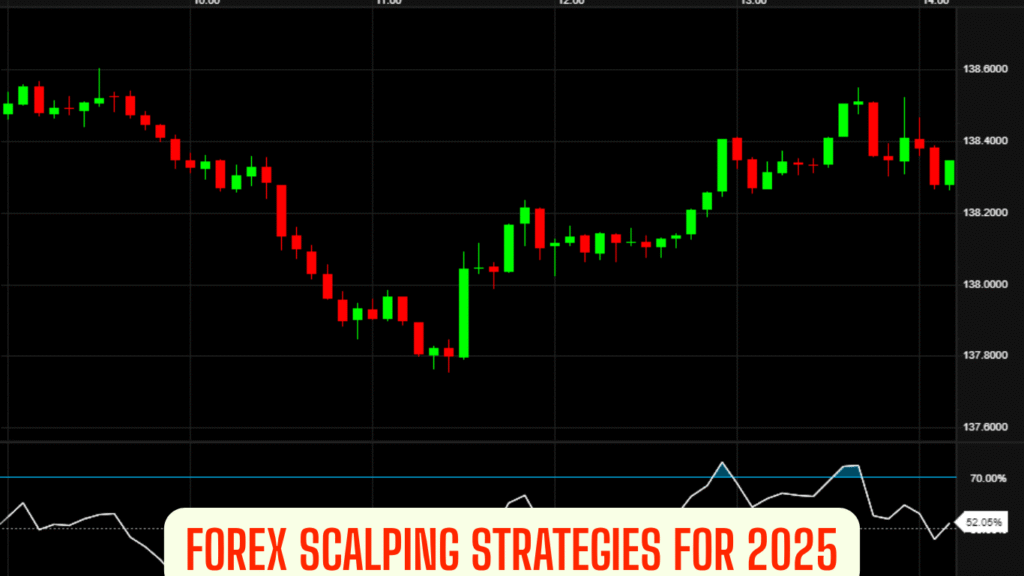
- RSI (Relative Strength Index): This momentum oscillator helps identify overbought and oversold conditions on short timeframes. Scalpers watch for RSI divergences and swings when the indicator exits overbought (above 70) or oversold (below 30) territories .
- MACD (Moving Average Convergence Divergence): Useful for spotting momentum shifts and trend direction through crossovers of its component lines. The histogram visualization helps gauge momentum strength .
- Bollinger Bands: These volatility bands help identify potential breakout points and overextended price moves when price touches or breaches the bands .
Popular Forex Scalping Strategies Explained
1. Scalping Breakouts Strategy
This approach focuses on capturing quick profits when price breaks through key technical levels:
- Identification: Watch for consolidation patterns like triangles or ranges with clearly defined support and resistance .
- Execution: Enter immediately after a confirmed breakout with increased volume, placing tight stop-loss orders just below the breakout level .
- Profit-taking: Aim for a 1:1 or 1:2 risk-reward ratio, exiting quickly if the breakout shows signs of weakness .
- Optimal conditions: Works best in high-volatility environments with clear technical levels and during session overlaps (like London/New York) that often catalyze movements .
2. Momentum Scalping Strategy
This strategy capitalizes on strong, short-term price movements:
- Identification: Use momentum indicators like RSI and MACD combined with volume analysis to confirm move strength .
- Execution: Enter trades in the direction of the established momentum, looking for strong candle patterns with long bodies and minimal wicks .
- Profit-taking: Set tight stop-losses (5-15 pips) and take profits quickly (10-25 pips) .
- Optimal conditions: Most effective in trending markets with clear directional moves and high trading volume .
3. Moving Average Scalping Strategy
This method uses moving average interactions for trade signals:
- Setup: Typically employs two moving averages—a faster one (5-10 periods) and a slower one (20-50 periods) .
- Execution: Enter long when price bounces up from the faster MA or go short when price rebounds down from the faster MA, using crossovers for additional confirmation .
- Profit-taking: Set tight stop-losses (5-10 pips) with profit targets at predetermined levels (10-20 pips) .
- Optimal conditions: Works best in trending markets with moderate volatility; less effective in ranging markets .
4. Scalping Dips Strategy
This approach buys temporary pullbacks within established uptrends:
- Identification: First identify a strong uptrend on short-term charts, then watch for temporary pullbacks to key support levels .
- Execution: Enter buy positions when price hits support levels or retracement zones with oversold confirmation from RSI or Stochastic .
- Risk management: Place tight stop-loss orders just below recent lows to protect against deeper corrections .
- Profit-taking: Exit as price recovers from the dip, capturing the resumption of the underlying trend .
5. Range Scalping Strategy
This technique profits from price oscillations within established boundaries:
- Identification: Find currency pairs moving sideways within clear support and resistance levels during consolidation periods .
- Execution: Buy near support and sell near resistance, or short at resistance and cover at support .
- Confirmation: Use additional indicators like Bollinger Bands or stochastic oscillators to validate entries and exits .
- Optimal conditions: Most effective during low-volatility market conditions when prices are bouncing predictably between established boundaries .
Risk Management: The Scalper’s Shield
Effective risk management separates sustainable scalping from account liquidation:
- Position sizing: Limit risk to 0.25%-0.5% of account capital per trade, acknowledging the high frequency of trading . More conservative traders might use the standard 1-2% risk rule, but scalpers benefit from smaller allocations due to trade volume .
- Stop-loss discipline: Implement tight stop-loss orders (5-10 pips) and treat them as inviolable—never moving them further away hoping for a reversal .
- Risk-reward ratios: While scalping often employs smaller ratios (1:1 or 1:2), the cumulative effect of multiple successful trades justifies this approach .
- Daily loss limits: Establish strict maximum daily loss limits (e.g., 2-3% of account) and cease trading immediately if reached to prevent emotional revenge trading .
- Cost awareness: Factor in spreads and commissions for each trade, as these transaction costs significantly impact profitability given the high trade frequency .
The Psychology of Successful Scalping
Scalping presents unique psychological challenges that must be mastered:
- Emotional detachment: The fast-paced nature requires making decisions based on predetermined rules rather than emotions. Fear and greed—the twin enemies of all traders—are particularly dangerous in scalping .
- Discipline over discretion: In prop firm environments especially, consistent execution of a tested system matters more than intuitive “gut feelings” about market direction .
- Focus and patience: Despite the rapid trading, successful scalping requires patience to wait for optimal setups rather than chasing marginal opportunities .
- Resilience after losses: With numerous trades executed daily, losses are inevitable. The key is to maintain composure and stick to your strategy without deviating from your plan after a losing trade .
Advantages and Disadvantages of Scalp Trading
Benefits of Scalping
- Frequent opportunities: Constant market fluctuations provide numerous trading setups throughout the day .
- Reduced overnight risk: Positions are closed before market closes, eliminating gap risk from overnight news or events .
- Smaller individual losses: Tight stop-losses limit potential damage from any single trade .
- Profit potential in various conditions: Scalpers can profit in both trending and ranging markets .
- Less capital requirements: Smaller accounts can achieve meaningful results due to high trade frequency .
Challenges of Scalping
- High stress levels: The rapid-fire decision-making can be mentally exhausting and unsustainable for some traders .
- Time-intensive: Requires constant screen monitoring and rapid execution, often for extended periods .
- Transaction cost accumulation: Frequent trading leads to higher commission costs that can significantly erode profits .
- Technology dependence: Relies on fast, reliable internet connections and trading platforms—technical glitches can be costly .
- Overtrading temptation: The constant search for opportunities can lead to taking subpar setups and increased losses .
Conclusion: Mastering the Art of Micro-Movements
Forex scalping represents a unique approach to trading that prioritizes frequency, precision, and discipline over large, infrequent gains. While demanding in terms of time, focus, and emotional control, it offers the potential for consistent profits through the accumulation of small, well-managed trades.
Success in scalping comes not from secret indicators or perfect market predictions, but from rigorous execution of a tested strategy, unwavering risk management, and the psychological discipline to follow your system through both winning and losing streaks. The strategies outlined in this guide—from breakout and momentum trading to moving average and range approaches—provide a foundation for developing your own scalping methodology.
Remember that consistent profitability requires specialized knowledge, disciplined risk management, and appropriate technology. Start with demo trading to refine your approach without financial risk, and gradually transition to live markets once you’ve proven your strategy’s effectiveness. In the fast-paced world of scalping, preparation and process ultimately trump impulse every time.
Disclaimer
This article is for educational and informational purposes only and does not constitute financial advice of any kind. Forex trading, particularly scalping, involves substantial risk and is not suitable for every investor. The possibility exists that you could sustain a loss of some or all of your initial investment, and therefore you should not invest money that you cannot afford to lose. Past performance is not necessarily indicative of future results. The author and publisher are not registered financial advisors and cannot provide personalized investment advice. You should consult with a qualified financial professional before making any investment decisions. All trading strategies are used at your own risk.
5 FAQs
1. Is forex scalping suitable for beginners, and what is the biggest mistake they make?
Answer: While technically accessible, forex scalping is one of the most challenging styles for beginners due to its fast pace and demand for intense discipline. The single biggest mistake novice scalpers make is overtrading—entering trades based on impulse rather than waiting for their strategy’s specific criteria to be met. Beginners are often tempted to “recover” from a small loss immediately or force trades when the market is slow, which leads to accumulated losses from spreads and poor setups. It is highly recommended to practice extensively on a demo account for several months before committing real capital.
2. How much capital do I need to start forex scalping effectively?
Answer: The required capital depends heavily on your broker’s leverage, your risk management rules, and the currency pairs you trade. While some brokers allow opening micro-lots with a small deposit, effective scalping requires enough capital to withstand the inevitable string of small losses without breaching your margin. More important than the total amount is proper position sizing. As highlighted in the article, you should never risk more than 0.25%-0.5% of your account on a single trade. For a $1,000 account, that’s just $2.50 to $5.00 per trade, which necessitates using smaller lot sizes to place tight stop-losses without exceeding your risk limit.
3. Why are tight spreads so crucial for a scalping strategy?
Answer: Tight spreads are non-negotiable for scalpers because the profit target per trade is so small—often just 5 to 10 pips. If the spread (the difference between the bid and ask price) is 2 pips on a EUR/USD trade, you are already down 2 pips the moment you enter. To reach a 10-pip profit target, the price must now move 12 pips in your favor. A wide spread can therefore consume a significant portion of your potential profit and make it mathematically much harder to be consistently profitable, especially when executing dozens of trades a day where these costs compound.
4. Which is more important for scalping: the entry signal or the exit strategy?
Answer: While a precise entry signal is important, a disciplined exit strategy is arguably more critical for long-term success. A good entry gets you into a profitable move, but a poor exit can turn a winner into a loser. Scalping is defined by its strict exit rules: taking profits quickly before the market reverses and, more importantly, cutting losses immediately with tight stop-loss orders. The mantra “let your winners run” does not apply to traditional scalping; the focus is on consistent, small gains and preserving capital by exiting losing trades without hesitation.
5. Can I use a scalping strategy on a mobile trading app, or do I need a desktop platform?
Answer: It is strongly discouraged to rely solely on a mobile app for active scalping. While modern apps are powerful, a dedicated desktop platform is essential for several reasons:
- Speed and Reliability: Desktop platforms offer faster execution and more stable connections, which is vital when every second counts.
- Advanced Charting: They provide the advanced, customizable charts with multiple technical indicators and timeframes that scalpers need to make quick decisions.
- Screen Real Estate: You need to monitor several charts and your trading terminal simultaneously, which is impractical on a mobile screen. Using a mobile app for scalping significantly increases the risk of technical glitches, slow execution, and costly errors.