
Forex trend following represents one of the most powerful and time-tested approaches in currency trading. This systematic methodology focuses on identifying and capitalizing on sustained price movements in major, minor, and exotic currency pairs. Unlike strategies that attempt to predict market tops or bottoms, trend following operates on a simple principle: ride established trends until clear reversal signals emerge. The philosophy is straightforward – buy during uptrends, sell during downtrends, and exit when the trend shows signs of exhaustion. This approach has demonstrated remarkable resilience across decades of market cycles, offering traders a structured framework for navigating the volatile foreign exchange market.
The appeal of trend following in Forex lies in its universal applicability across various timeframes, from scalpers operating on minute charts to position traders analyzing weekly or monthly trends. While the fundamental concept remains simple, successful implementation requires disciplined execution, robust risk management, and the psychological fortitude to endure inevitable periods of drawdowns. This comprehensive guide explores the intricacies of Forex trend following, providing actionable strategies and insights to help both novice and experienced traders capture significant portions of major currency movements.
Understanding Trend Following: Foundations and Mindset
At its core, Forex trend following is about reacting to market movements rather than predicting future prices. This distinction separates it from many other trading approaches and forms the foundation of its effectiveness. Trend followers acknowledge that markets trend approximately 30-35% of the time, with the remainder spent in consolidation phases. The strategic objective is to capture substantial portions of these trending periods while minimizing losses during range-bound conditions.
The psychological dimension of trend following cannot be overstated. Successful practitioners embrace several key mental frameworks:
- Patience and Discipline: Trends develop over time, requiring traders to wait for high-probability setups and adhere strictly to their trading rules even during drawdowns .
- Comfort with Imperfection: Trend followers never catch the exact bottom or top of a move. Instead, they focus on capturing the middle, most reliable portion of a trend, accepting that some profit must be left on the table for both entry and exit .
- Resilience Through Loss Periods: Unlike strategies with high win rates, trend following typically involves more losing trades than winners, requiring emotional stability to persist through strings of small losses while waiting for the large winners that make the strategy profitable .
This methodology fundamentally aligns with how currency markets behave, driven by long-term economic cycles, interest rate differentials, and gradual shifts in global capital flows that create sustained trending conditions across currency pairs.
Identifying and Quantifying Trends in Forex Markets
Before implementing any trend following strategy, traders must first establish objective criteria for what constitutes a trend. The Forex market offers numerous technical tools for this purpose:
Chart-Based Analysis
- Trendline Analysis: Drawing lines connecting successive higher lows in uptrends or lower highs in downtrends provides visual confirmation of trend direction .
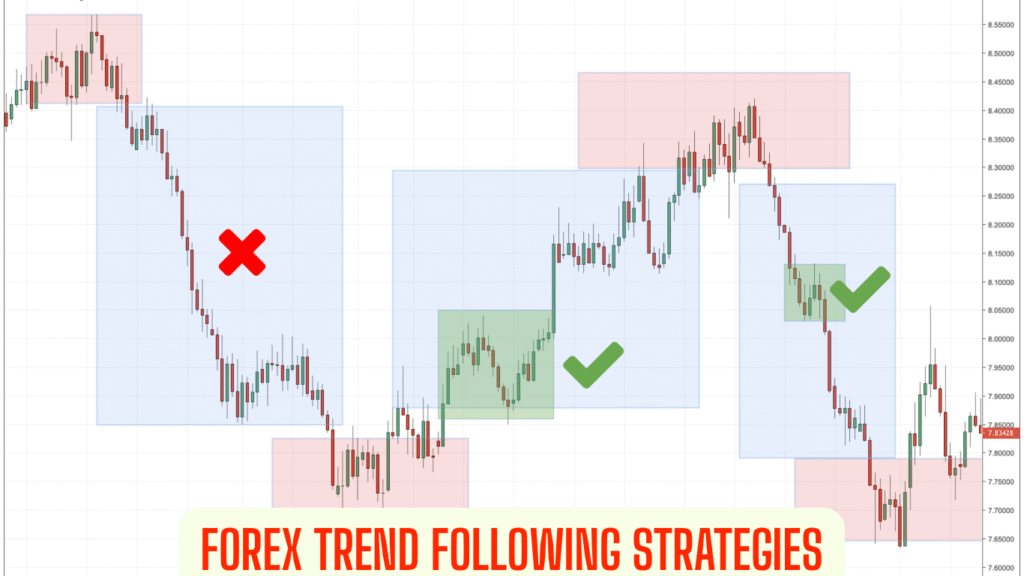
- Price Structure Evaluation: Uptrends display characteristic higher highs and higher lows, while downtrends establish lower highs and lower lows. This price action analysis forms the foundation of all trend identification .
Technical Indicators for Trend Quantification
- Moving Averages: These remain the most popular trend identification tools. The relationship between price and key moving averages (such as the 50, 100, or 200-period) provides clear, objective trend definitions . When price trades above a moving average, the trend is considered bullish; when below, bearish.
- Multiple Moving Average Systems: Using two or three moving averages of different periods (e.g., 50/100 or 50/100/200 combinations) creates more robust trend filters and generates specific entry and exit signals .
- Average Directional Index (ADX): This indicator measures trend strength without regard to direction. Readings above 25 typically indicate a strong trend, while readings below 20 suggest ranging market conditions .
Table: Popular Technical Indicators for Forex Trend Following
| Indicator | Primary Function | Common Settings | Interpretation |
|---|---|---|---|
| Moving Averages | Trend Direction | 50, 100, 200 periods | Price above = Uptrend, Price below = Downtrend |
| ADX | Trend Strength | 14 periods | >25 = Strong trend, <20 = Weak trend/Ranging |
| Parabolic SAR | Trend Direction & Reversals | 0.02 step, 0.2 maximum | Dots below price = Uptrend, Dots above = Downtrend |
| MACD | Momentum & Trend Changes | 12,26,9 | Line crossover = Potential trend shift |
The most effective approach combines multiple confirmation methods to distinguish genuine trends from temporary price spikes or ranges.
Proven Forex Trend Following Strategies
Moving Average Crossover Systems
This classic approach uses two or more moving averages to generate entry and exit signals:
- Dual Moving Average Strategy: Uses a faster (e.g., 50-period) and slower (e.g., 100-period) moving average. A bullish crossover occurs when the faster MA crosses above the slower MA, generating a buy signal. A bearish crossover happens when the faster MA crosses below the slower MA, triggering a sell signal . This system ensures traders are always positioned with the prevailing trend.
- Triple Moving Average Strategy: Adds a third, longer-term moving average (e.g., 200-period) as a trend filter. Trades are only taken in the direction of the longest moving average, providing an additional layer of confirmation and potentially reducing whipsaws during ranging markets .
Breakout Strategies
Breakout strategies focus on capturing the initial momentum when currency pairs exit consolidation periods:
- Donchian Channel Breakout: This system uses channels formed by the highest high and lowest low over a specified period (typically 20-50 periods). A long position is initiated when price breaks above the upper channel, while a short position is entered when price breaks below the lower channel .
- Volatility-Based Breakouts: Using indicators like Average True Range (ATR), traders can set dynamic breakout levels that adapt to changing market conditions. For example, a breakout might be confirmed when price moves beyond a 1.5 ATR multiple from a recent pivot point .
Multi-Indicator Confirmation Systems
Sophisticated trend followers often combine multiple non-correlated indicators to filter false signals:
- Trend/Momentum Combinations: Using ADX for trend strength confirmation alongside moving average crossovers can significantly improve signal quality. For instance, only taking moving average crossover signals when ADX readings are above 25 .
- Volume-Conformed Breakouts: While Forex lacks centralized volume data, tick volume or volume-weighted indicators can help confirm the strength behind breakouts, separating genuine trend initiations from false breakouts.
Risk Management: The Foundation of Sustainable Trend Following
Effective risk management separates successful trend followers from those who eventually blow up their accounts. Several key principles must be incorporated into every trend following system:
Position Sizing Techniques
- Fixed Fractional Position Sizing: This approach risks a fixed percentage of account capital on each trade (typically 0.5-2%). As the account grows, position sizes increase proportionally, while during drawdowns, positions sizes decrease automatically to preserve capital .
- Volatility-Adjusted Position Sizing: Using the Average True Range (ATR), traders adjust position sizes based on current market volatility. More volatile pairs receive smaller position sizes to normalize risk across all trades, while less volatile pairs can accommodate larger positions .
Stop-Loss Placement Strategies
- ATR-Based Stops: Setting stop-loss orders at a multiple of ATR (e.g., 1.5-2 ATR) from entry provides dynamic protection that adapts to changing market conditions .
- Technical Level Stops: Placing stops beyond recent swing highs/lows or key support/resistance levels aligns risk management with market structure.
Portfolio-Level Considerations
- Currency Pair Diversification: Trading multiple non-correlated currency pairs (e.g., combining majors, crosses, and exotics) reduces portfolio volatility and smooths equity curves .
- Timeframe Diversification: Implementing trend following strategies across multiple timeframes (e.g., daily, 4-hour, and hourly) can capture trends of different magnitudes and reduce the impact of periods when specific timeframes are range-bound.
The Psychology of Successful Trend Following
The mental aspect of trend following presents the greatest challenge for most traders. Several psychological hurdles must be overcome:
- Embracing Low Win Rates: Trend following systems typically have win rates between 30-40%, meaning traders experience losing trades more frequently than winning ones . The profitability comes from the asymmetric payoff where average winning trades are significantly larger than average losers.
- Sticking With Drawdowns: Even the most robust trend following systems experience extended drawdown periods. Maintaining discipline and adherence to the system during these challenging periods is essential for long-term success .
- Avoiding Optimization Bias: Over-optimizing systems to historical data creates curve-fit strategies that typically fail in live markets. The most durable trend following approaches use simple, robust parameters that work across multiple currency pairs and market conditions.
Legendary trend follower Ed Seykota encapsulated the required mindset with his three fundamental rules: “Cut losses quickly, ride winners, and keep bets small” . This philosophy remains as relevant today as when he first articulated it.
Performance Expectations and Realistic Outcomes
Understanding what to expect from trend following strategies helps traders maintain perspective during challenging periods:
- Win Rate Realities: Most trend following systems achieve win rates between 25-50%, with 35-40% being typical for well-constructed approaches . This means experiencing 6-7 losing trades for every 3-4 winners is normal.
- Reward-to-Risk Ratios: While win rates are modest, the strategy’s power comes from high reward-to-risk ratios on winning trades. Successful systems typically show average winners that are 2-5 times larger than average losers, creating positive expectancy despite more frequent losses .
- Drawdown Characteristics: Drawdowns of 20-35% are not uncommon even in profitable trend following systems . The key is ensuring that drawdowns remain within manageable levels relative to account size and trader risk tolerance.
Historical backtesting of simple trend following systems on Forex pairs shows compound annual growth rates (CAGR) ranging from 15-30% with proper risk management, though past performance never guarantees future results .
Conclusion: Mastering the Art of Trend Following
Forex trend following offers a systematic, disciplined approach to capturing significant portions of major currency movements. While conceptually simple, its successful implementation requires robust risk management, psychological resilience, and unwavering discipline. The strategies outlined in this guide – from moving average crossovers to breakout systems – provide a foundation for developing your own trend following methodology.
The enduring appeal of trend following lies in its alignment with how markets actually behave. Currencies trend because global capital flows shift gradually in response to changing economic fundamentals, and these shifts persist over weeks, months, or even years. By riding these trends while strictly managing risk, traders can position themselves to capture the outsized gains that make the strategy profitable over time.
Remember that consistency and process trump short-term results. Focus on executing your system flawlessly, manage your risk meticulously, and let the markets take care of the profits. In the world of trend following, discipline isn’t just a virtue – it’s the foundation of sustainable success.
Disclaimer
This article is for educational and informational purposes only and does not constitute financial advice, investment recommendation, or an offer or solicitation to buy or sell any financial instruments. The strategies discussed involve substantial risk of loss and may not be suitable for all investors. Past performance of any trading system is not necessarily indicative of future results. You should consult with a qualified financial advisor before making any investment decisions. Trading foreign exchange on margin carries a high level of risk, and you should only risk capital you are prepared to lose. The author and publisher are not responsible for any losses or damages arising from the use of this information.
5 FAQs
1. What is the biggest psychological challenge in trend following, and how can I overcome it?
Answer: The biggest challenge is coping with the low win rate and enduring extended drawdown periods. Unlike strategies that boast high success rates, trend following often has win rates between 30-40%, meaning you will experience more losing trades than winning ones. This can be psychologically draining and may tempt you to abandon your strategy. The solution is to trust in the system’s positive expectancy—the fact that the average winning trade is significantly larger than the average loser. Overcoming this requires a focus on strict process over short-term results and the discipline to execute your plan consistently, even during strings of losses.
2. I often get “whipsawed” by moving average crossovers in a ranging market. How can I filter out these false signals?
Answer: Whipsaws are a common drawback of moving average systems. To filter them out, you can:
- Use a Trend-Filter: Add a longer-term moving average (like the 200-period) and only take trades in the direction of this primary trend. For example, only take bullish crossovers when the price is above the 200 MA.
- Incorporate the ADX Indicator: Use the Average Directional Index (ADX) to confirm trend strength. Only act on crossover signals when the ADX is above a threshold like 25, indicating a strong trend is present and reducing entries in weak, choppy markets.
- Switch to Higher Timeframes: Signals on daily or weekly charts are typically more reliable and less prone to noise than those on shorter timeframes like the 1-hour or 15-minute charts.
3. Why is risk management even more critical in trend following than in other strategies?
Answer: Risk management is the cornerstone of trend following because the strategy relies on a few large winners to offset many small losses. Without strict risk controls, a string of small losses could severely deplete your capital before you ever catch a major trend. Key techniques include:
- Position Sizing: Risking only a small percentage (e.g., 0.5-1%) of your account per trade to survive drawdowns.
- Volatility-Adjusted Stops: Using indicators like Average True Range (ATR) to place stop-loss orders that account for current market volatility, preventing you from being stopped out by normal price fluctuations.
- This disciplined approach to preserving capital is what allows you to stay in the game long enough to profit from the big trends.
4. Can trend following be applied to short-term timeframes like scalping, or is it only for long-term trading?
Answer: While trend following is most commonly associated with daily and weekly charts, its core principles can be applied to any timeframe, including shorter ones like the 1-hour or 4-hour charts. However, the nature of the trends changes. On shorter timeframes, you will be capturing smaller trends that last for hours or days, and you will face more market noise and a higher frequency of trades. The key is to adjust your tools accordingly—using faster moving averages and a tighter tolerance for ADX readings. For most traders, beginning with daily charts is recommended as it provides more reliable signals and is less time-intensive.
5. How do I know when to exit a profitable trend-following trade?
Answer: Exiting a trend is often harder than entering. The goal is to ride the trend as long as it persists without giving back too much profit. Common exit techniques include:
- Trailing Stop-Loss: Using a moving average or an ATR-based trailing stop. For instance, you could exit a long trade when the price closes below the 50-period moving average. This allows you to stay in the trend while locking in profits as the price moves in your favor.
- Trend Exhaustion Signals: Watching for a break of a significant trendline or a bearish moving average crossover (for a long trade) as a signal that the trend may be reversing.
- It’s crucial to remember that you will never sell at the very top or buy at the very bottom. The goal is to capture the middle, meaty portion of the trend.