
Forex scalping represents one of the most fast-paced and potentially rewarding trading styles in the financial markets. This comprehensive guide delves deep into the world of scalping, revealing proven strategies, optimal trading conditions, and critical risk management techniques that can help both novice and experienced traders navigate this intense trading approach. By mastering these forex scalping techniques, you’ll learn how to capitalize on microscopic price movements that most traders overlook, transforming seemingly insignificant market fluctuations into consistent profits.
What is Forex Scalping? An In-Depth Explanation
Forex scalping is a specialized trading style where traders execute a large number of extremely short-term positions throughout the trading day, targeting small profit margins from each individual trade . Essentially, scalpers seek to profit from tiny ‘micro trends’ that emerge in the market, opening positions as these mini-trends begin and closing them the moment they show signs of reversing. Unlike day traders who might hold positions for hours, scalpers typically maintain trades for mere minutes or even seconds .
The fundamental philosophy behind scalping contradicts conventional trading wisdom that preaches “letting profits run.” Instead, scalpers embrace the mantra “take profits early and often.” This approach aims to accumulate numerous small gains that collectively compound into significant returns over time. While the profit per trade might be modest—often just a few pips—the high frequency of trades can lead to substantial overall profitability when executed with discipline and precision .
Scalping differs significantly from other trading approaches like swing trading or position trading, where traders hold positions for days, weeks, or even months. While these longer-term strategies seek to capture major market movements, scalping operates in a compressed timeframe where speed, precision, and impeccable timing are paramount. This method requires constant attention to the markets and the ability to make rapid decisions under pressure, making it both mentally demanding and potentially rewarding for those who master its nuances.
Core Principles of Effective Scalping
Successful scalping rests on several foundational principles that distinguish it from other trading methodologies. Understanding and adhering to these core concepts is essential for anyone serious about pursuing this trading style:
- Ultra-Short Time Frames: Scalpers primarily operate on very short time frames, with 1-minute, 3-minute, and 5-minute charts being the most popular choices . These compressed chart intervals allow traders to spot micro-movements and entry opportunities that would be invisible on longer time frames. The ability to read and interpret price action on these minimal time frames is a critical skill that separates successful scalpers from the rest.
- Small Profit Targets: Unlike traditional traders who might seek gains of 50-100 pips per trade, scalpers typically target much smaller profits, often in the range of 5-15 pips per trade . This modest approach allows them to quickly take profits and move to the next opportunity without waiting for extended price movements to develop.
- High Win Rate Requirement: Since the risk-reward ratio on individual scalping trades is often tight (sometimes as low as 1:1), maintaining a high win rate is crucial for long-term profitability . A series of losses can quickly erase the gains from multiple successful trades, making consistency more important than home runs.
- Strict Discipline: The rapid-fire nature of scalping demands unwavering discipline . This includes the discipline to enter precisely when your strategy signals, exit immediately when price action turns against you, and avoid emotional decision-making that can lead to devastating losses.
- Minimal Market Exposure: By design, scalping minimizes the time a trader remains in the market, thereby reducing exposure to unforeseen events or sudden volatility spikes that can occur with longer-term positions .
Proven Forex Scalping Strategies for Consistent Results
Moving Average Crossover Strategy
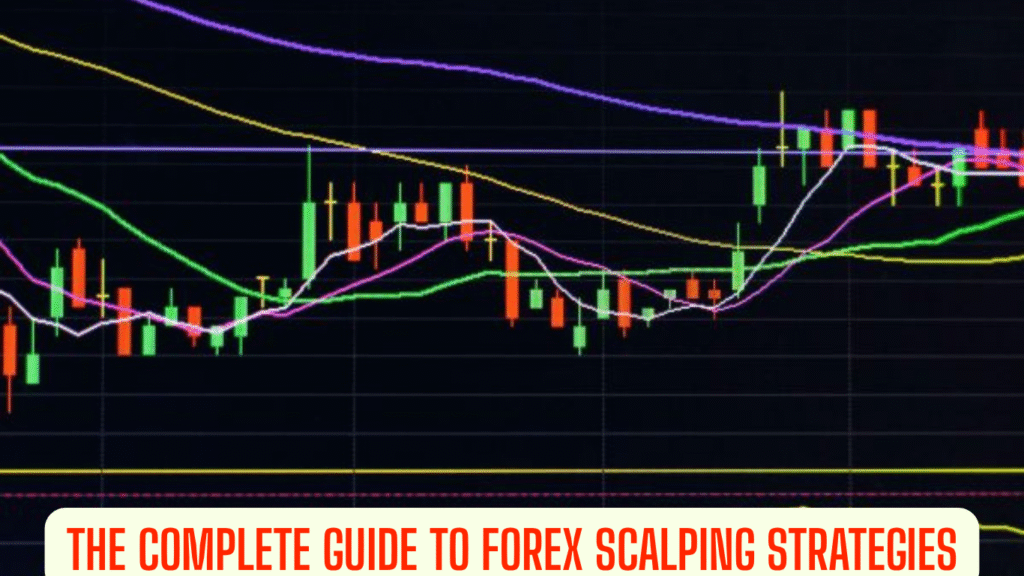
The Moving Average Crossover strategy is among the most reliable and widely-used approaches in a scalper’s arsenal. This method typically employs two or three Exponential Moving Averages (EMAs) with different periods to identify the short-term trend direction and potential entry points.
Implementation Steps:
- Apply three EMAs to your chart: commonly used periods include 8, 13, and 21
- Use a higher time frame (such as H1) to establish the overall trend direction
- Switch to a 5-minute chart to fine-tune entry points in the direction of the higher-timeframe trend
- Enter a long position when the faster EMA (e.g., 8-period) crosses above the slower EMA (e.g., 21-period) in an uptrend
- For short positions, enter when the faster EMA crosses below the slower EMA in a downtrend
- Set tight stop-loss orders (typically 5-10 pips) and take-profit targets at a 1:1 or 1:1.5 risk-reward ratio
This strategy works exceptionally well in trending market conditions but may generate false signals during ranging periods. Many experienced scalpers add a third EMA as a filter to confirm the trend direction and avoid whipsaws.
Breakout Scalping Strategy
Breakout scalping focuses on capturing price movements when currency pairs breach significant support or resistance levels. This strategy capitalizes on the increased volatility and directional momentum that often follows such breakouts.
Implementation Steps:
- Identify key support and resistance levels on a 15-minute or 5-minute chart during periods of consolidation
- Wait for the price to approach and test these boundaries
- Enter a long position when price decisively breaks above resistance or a short position when it breaks below support
- Use volume indicators or momentum oscillators like the RSI to confirm the strength of the breakout
- Place stop-loss orders just inside the broken level (below resistance for long trades, above support for short trades)
- Set profit targets at the next significant support/resistance level or use a fixed pip target of 8-15 pips
This strategy is particularly effective during the overlapping sessions of major financial centers (London-New York, Tokyo-London) when liquidity and volatility are at their peak .
Bollinger Bands Bounce Strategy
Bollinger Bands provide an excellent visual representation of price volatility and can be highly effective for scalping in ranging markets.
Implementation Steps:
- Apply Bollinger Bands with standard settings (20-period moving average with 2 standard deviations) to a 5-minute chart
- Identify situations where price is bouncing between the upper and lower bands without a strong directional trend
- Enter a long position when price touches or crosses below the lower band and shows signs of reversing upward
- Enter a short position when price touches or crosses above the upper band and shows signs of reversing downward
- Use additional confirmation from candlestick patterns (such as doji, hammers, or engulfing patterns) to validate entry signals
- Set stop-loss orders just beyond the band that triggered the entry, with profit targets at the opposite band or middle band
This mean-reversion strategy works best in sideways markets but should be avoided during strong trending conditions when prices can “walk the bands” for extended periods.
RSI Divergence Strategy
The Relative Strength Index (RSI) can help scalpers identify potential reversal points before they become evident in pure price action.
Implementation Steps:
- Apply a 14-period RSI to your 5-minute or 15-minute chart
- Look for divergence patterns where price makes a higher high but RSI makes a lower high (bearish divergence), or price makes a lower low but RSI makes a higher low (bullish divergence)
- Enter trades in the direction suggested by the divergence
- Combine with key support/resistance levels for additional confirmation
- Set tight stop-losses beyond the recent swing high/low that created the divergence
- Take quick profits as price moves in the anticipated direction
This counter-trend approach requires precision and should ideally be used in conjunction with other confirming indicators to avoid false signals.
Optimal Conditions for Forex Scalping
Best Currency Pairs for Scalping
| Pair Type | Examples | Why Suitable |
|---|---|---|
| Major Pairs | EUR/USD, GBP/USD, USD/JPY | High liquidity, tight spreads, minimal slippage |
| Minor Pairs | EUR/JPY, GBP/JPY | Higher volatility, larger movements to exploit |
Ideal Trading Sessions
The most favorable conditions for scalping occur during periods of high market liquidity and volatility, which typically coincide with the overlapping trading sessions of major financial centers:
- London-New York Overlap (1pm-4pm UTC): Considered the prime scalping window due to exceptionally high liquidity and volatility
- Tokyo-London Overlap (8am-9am UTC): Offers increased activity as Asian traders hand off to European counterparts
- Tokyo-Sydney Overlap (12am-7am UTC): Provides opportunities during the Asian session for those in compatible time zones
Scalping during these high-activity periods helps ensure sufficient price movement to capture profits while minimizing the impact of spreads due to high liquidity.
Essential Risk Management Techniques for Scalpers
Effective risk management is the cornerstone of sustainable scalping. Without it, the high frequency of trades can quickly lead to significant losses:
- Position Sizing: Never risk more than 1-2% of your trading capital on a single trade . This ensures that a string of losses won’t devastate your account and allows you to continue trading another day.
- Tight Stop-Losses: Implement very close stop-loss orders, typically 5-15 pips from entry, to limit potential losses when trades move against you . The exact placement should be based on recent support/resistance levels or volatility measurements.
- Consistent Risk-Reward Ratios: Maintain disciplined risk-reward parameters, even if they’re relatively tight (1:1 or 1:1.5) . Avoid the temptation to alter your ratios mid-session based on emotions or recent results.
- Daily Loss Limits: Establish a maximum allowable loss for each trading day. Once reached, stop trading immediately to prevent emotional decisions and potential revenge trading.
- Spread Consideration: Factor in the spread cost when calculating potential profits. During high-volatility periods, spreads can widen significantly, turning theoretically profitable setups into losing trades.
- Technology Backup: Have contingency plans for technical failures, including internet connectivity issues or platform malfunctions . These can be especially devastating for scalpers who rely on precise, timely executions.
Psychological Challenges and How to Overcome Them
Scalping presents unique psychological demands that test even experienced traders:
- Decision Fatigue: The constant need for rapid decision-making throughout trading sessions can lead to mental exhaustion and impaired judgment. Combat this by taking regular breaks, staying hydrated, and limiting session length to maintain peak mental acuity.
- Emotional Discipline: The fast pace and frequency of trades can trigger emotional responses like fear, greed, or frustration. Develop a pre-trade ritual, follow your trading plan relentlessly, and practice mindfulness techniques to maintain emotional equilibrium.
- Overtrading Temptation: The availability of constant opportunities can lead to entering marginal trades that don’t meet all strategy criteria. Remain selective and remember that not trading is sometimes the best trade.
- Handling Losses: Even successful scalpers experience frequent small losses. Learn to accept these as a normal cost of doing business rather than personal failures. Analyze losses for improvement opportunities, but don’t dwell on them emotionally.
- Patience and Impulsivity: Surprisingly, successful scalping requires immense patience to wait for optimal setups rather than jumping into subpar opportunities. Practice waiting for your specific criteria to align perfectly before entering any trade.
Conclusion: Mastering the Art of Scalping
Forex scalping represents a unique and challenging approach to currency trading that offers potential rewards commensurate with its demands. By employing proven strategies like Moving Average crossovers, Breakout techniques, Bollinger Bands bounces, and RSI divergences, while adhering to strict risk management protocols, traders can navigate the fast-paced world of scalping successfully. Remember that consistency, discipline, and continuous improvement are more valuable than any single indicator or strategy.
The path to scalping mastery requires dedication, practice, and emotional resilience. Begin with a demo account to refine your techniques without financial risk , gradually transitioning to live trading as your skills and confidence grow. Whether you choose to specialize in a single strategy or employ multiple approaches based on market conditions, the principles outlined in this guide will provide a solid foundation for your scalping endeavors. In the dynamic world of Forex trading, scalping remains a sophisticated method for those equipped with the right tools, mindset, and dedication to excel in one of trading’s most demanding disciplines.
Disclaimer: The information provided in this article is for educational purposes only and should not be construed as financial advice. Trading Forex carries a high level of risk and may not be suitable for all investors. There is a possibility that you could sustain a loss of some or all of your initial investment, therefore you should not risk more than you are prepared to lose. Past performance is not necessarily indicative of future results. Before undertaking any trading strategy, you should seek advice from an independent financial advisor to ensure you understand the risks involved.
5 FAQs
1. What is Forex scalping and how does it work?
Forex scalping is a short-term trading style where traders open and close a large number of positions within minutes or even seconds to capture small price movements. The goal is to accumulate many tiny profits that can add up to significant gains over time.
2. Which Forex scalping strategies are most effective?
Some proven scalping strategies include the Moving Average Crossover, Breakout Scalping, Bollinger Bands Bounce, and RSI Divergence strategies. Each strategy focuses on specific market conditions, such as trending or ranging markets, and relies on precise timing and execution.
3. What are the best currency pairs for scalping?
Major pairs like EUR/USD, GBP/USD, and USD/JPY are ideal for scalping due to high liquidity and tight spreads. Minor pairs such as EUR/JPY or GBP/JPY can also be used, offering more volatility and larger price movements to exploit.
4. How can risk be managed effectively in scalping?
Risk management techniques include using tight stop-loss orders (5-15 pips), limiting daily losses, controlling position size (1-2% of capital per trade), and maintaining consistent risk-reward ratios. Proper risk management prevents small losses from accumulating into significant drawdowns.
5. What psychological skills are important for Forex scalping?
Scalping requires discipline, emotional control, patience, and the ability to make rapid decisions without being influenced by fear or greed. Avoiding overtrading, handling losses calmly, and maintaining focus during high-speed trading sessions are key to success.